
Know Exactly What Your Customers Search.
Every page on your site should target something real people type into Google. I research what those searches are, how hard each one is to rank for, what the person wants when they search it, and which page on your site should answer it. You get the whole thing as a spreadsheet you keep.
Why Keyword Research Comes First
It is the cheapest decision in SEO and the one everything else depends on. Pick the wrong keywords and every hour you spend writing, building links and fixing pages goes toward rankings nobody is searching for.
You stop guessing what to write
Without research you write what you think customers want. With it, you write what they actually typed into Google last month, with the number next to it.
You avoid keywords you cannot win
Some terms are owned by national brands with thousands of links. Difficulty tells you which fights are worth having and which to leave alone for now.
Intent decides what the page should be
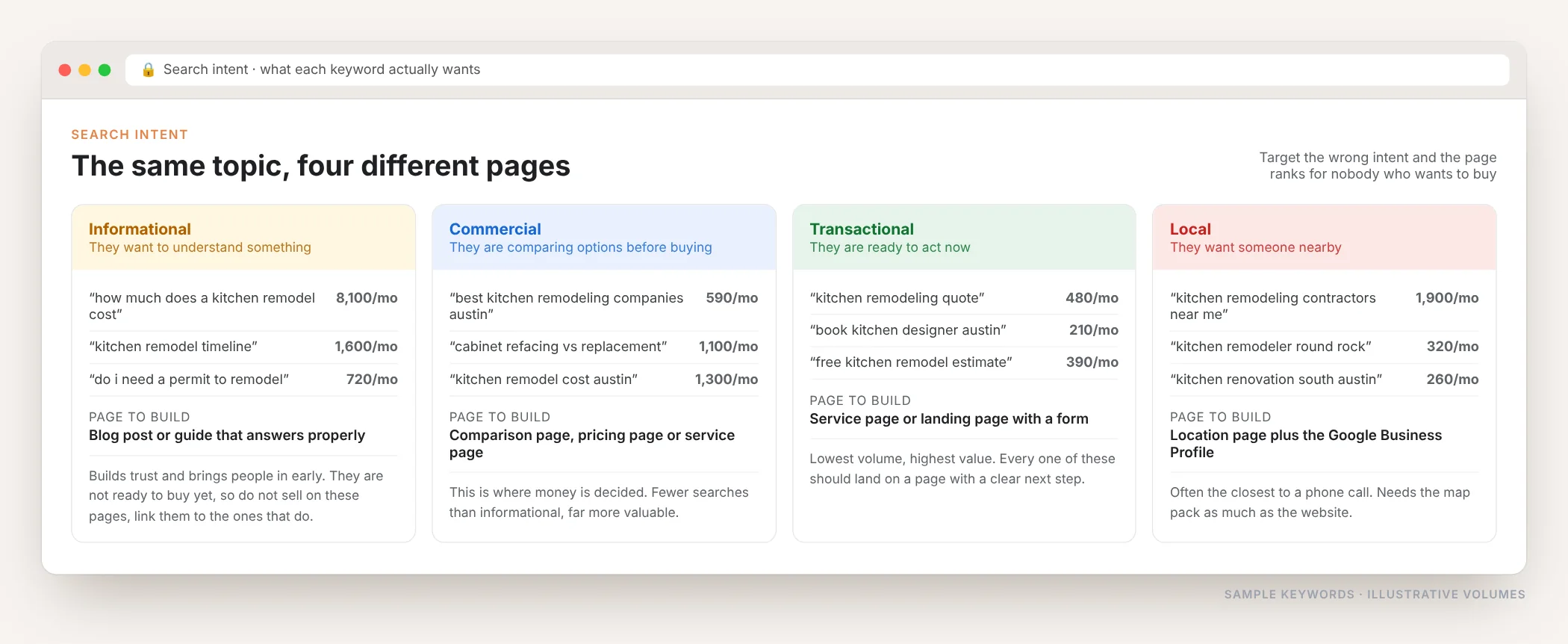
“Kitchen remodel ideas” and “kitchen remodel quote” are the same topic and completely different pages. Matching intent is the difference between traffic and enquiries.
Your pages stop competing with each other
Six posts about the same thing split your authority and none of them rank. One keyword per page, decided up front, prevents it.
It shows where the money is
Search volume is not value. A keyword with 300 searches and buying intent is worth more than one with 20,000 searches from people just browsing.
It becomes your content plan
The research is not a report you read once. It is the list you work through: what to publish next, what to update, and what to leave alone.
What Every Keyword Gets
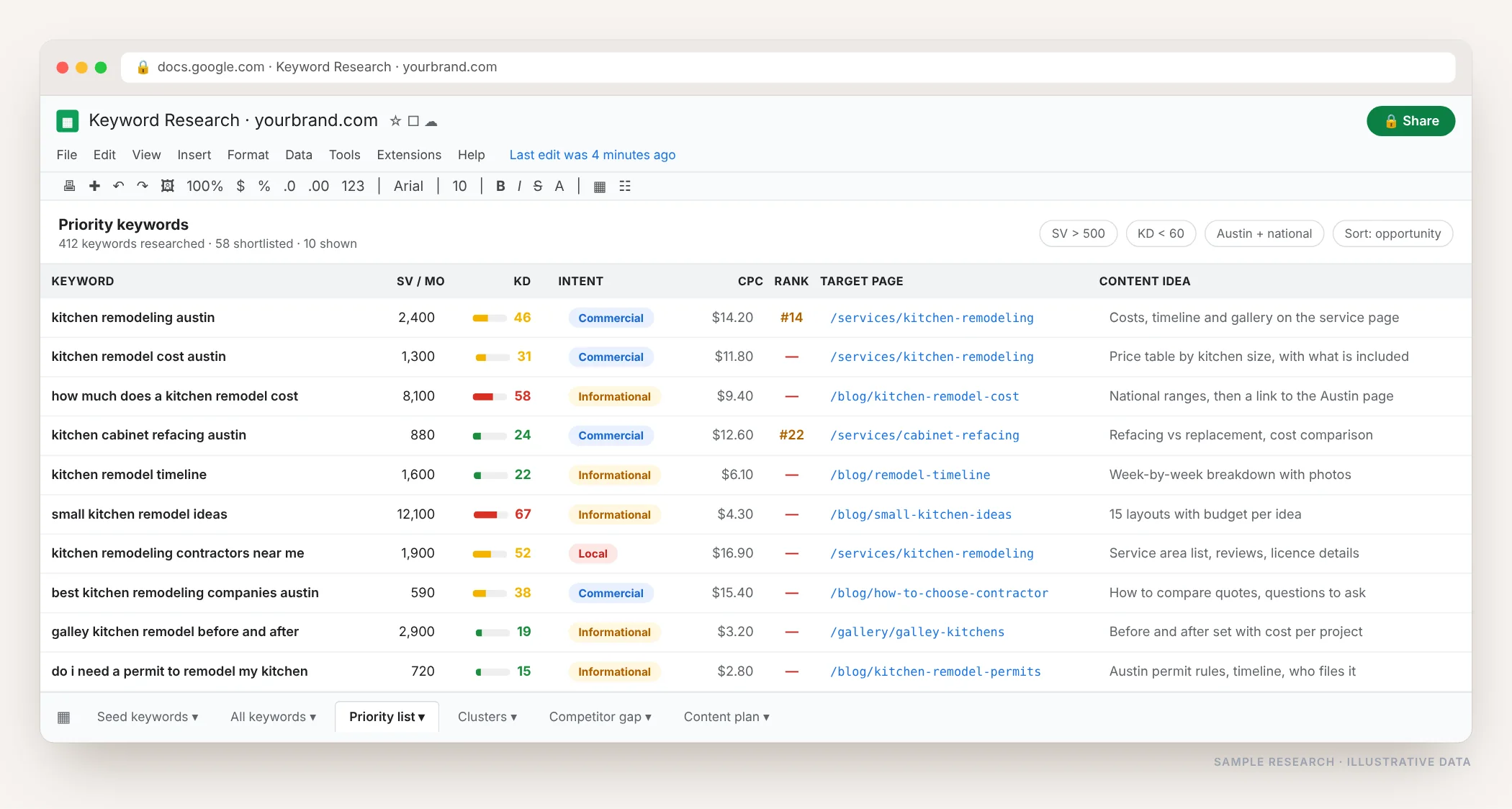
A keyword on its own tells you nothing. These are the numbers that turn a list into a decision:
- SV (search volume): how many people search it each month, in your country
- KD (keyword difficulty): how hard it is to rank, from 0 to 100, based on who already ranks
- Intent: what the searcher actually wants, which decides what kind of page to build
- CPC: what advertisers pay per click, a useful signal of commercial value
- Current rank: where you sit today, so you can see quick wins on page two
- Target page: which URL should own this keyword, new or existing
- Content idea: what the page needs to cover to actually win it
Keywords Grouped Into Pages
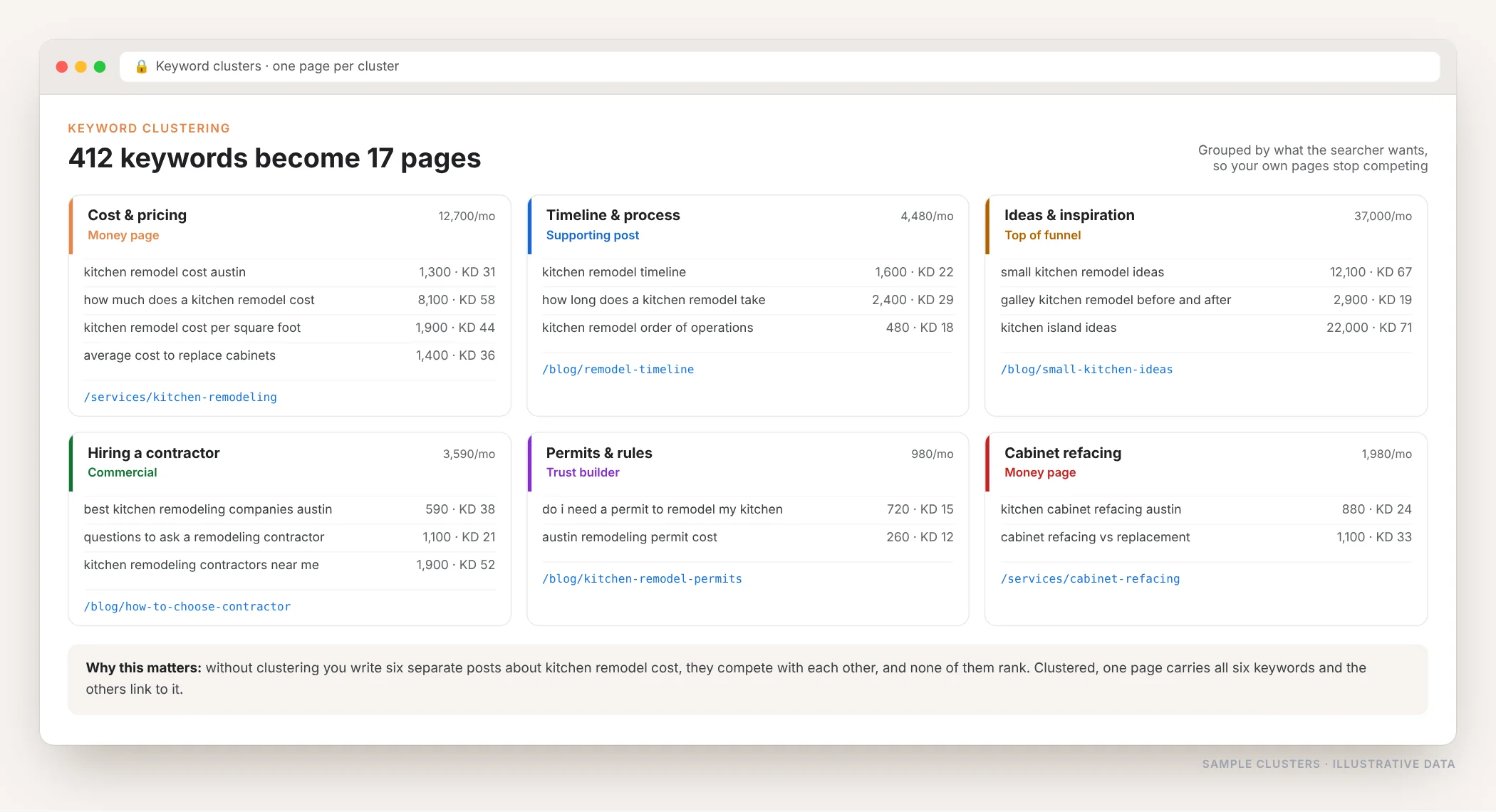
A list of 400 keywords is not a plan. I group them by what the searcher wants, so each group becomes one page that can carry the whole cluster, instead of five thin posts fighting each other.
What They Rank For And You Do Not
Your competitors have already paid for the testing. Every keyword bringing them traffic that your site does not appear for is a gap, and gaps are usually the fastest wins in the whole plan, because you already know the demand is real and you can see exactly what it takes to compete.
- Three to five direct competitors pulled apart keyword by keyword
- Terms where two or more of them rank and you do not appear at all
- Terms where you rank on page two and they sit in the top five
- How strong the page beating you actually is, not just its position
- A priority on every row, so you know what to write first
The gap list on its own is often enough work for three months.
Can You Actually Win This Keyword?
A difficulty score is an estimate. Before a keyword goes on your plan I open the search results and look at what is really ranking: how long those pages are, how many sites link to them, what they cover, and whether the page type matches what the searcher wants. That is what tells you whether a keyword is winnable or a waste of six months.
Who is ranking
National brands and directories mean one thing. Businesses your size mean the keyword is open.
What the page type is
If every result is a guide, a service page will not rank there no matter how good it is.
How much is on the page
Word count, sections covered, images, pricing, FAQs — the bar you have to clear to compete.
How many links it took
A page ranking on content alone is beatable this quarter. One with 200 links is not.
What else is on the results page
AI Overviews, map packs, People Also Ask and ads all change how many clicks position one actually gets.
The verdict
Go after it now, go after it later, or leave it. Written out, with the reason, on the keyword line.
Which Keywords To Go After First
Not every keyword in the research is for right now. Plotting difficulty against volume shows you the order to work in: the ones that bring real traffic without a fight, then the ones worth building toward, and the ones to leave to the brands with thousands of links.
- Go first: low difficulty with real volume, the pages that bring your first traffic, often within weeks
- Worth doing: medium difficulty, winnable once you have a few pages ranking and some links
- Later: needs stronger content and more authority than the site has today
- Leave for now: owned by national brands, and chasing them costs months for nothing
Signs Your Keywords Were Never Researched
- Pages targeting terms with no real search volume
- Everything aimed at one or two huge keywords you will never rank for
- Several pages written about the same thing, all stuck on page two
- Blog posts that bring traffic but never an enquiry
- Service pages written in your words, not the words customers use
- No idea which page is supposed to rank for what
- Keywords translated word for word from another language
- Content written for the industry, not the buyer
- Local searches ignored while chasing national terms
- Long-tail questions nobody has answered on your site
- Competitors ranking for terms you have never even seen
- Impressions in Search Console for keywords you never targeted
What Is in the Research
The full keyword list
Every keyword found for your business, with volume, difficulty, intent, CPC and your current rank. Hundreds of rows, not a dozen.
A priority shortlist
The ones actually worth going after, filtered by difficulty, volume and how close they are to a sale.
Clusters
Keywords grouped by what the searcher wants, so each group becomes one page instead of five.
Keyword to page mapping
Which URL should own each keyword, whether it already exists or needs writing.
Competitor gap
What your competitors rank for that you do not, which is usually where the easiest wins are.
Content ideas
For each page, what it actually needs to cover to beat what is already ranking.
My Keyword Research Process
Seed
Your services, your customers’ words, your Search Console data and three competitors.
Expand
Hundreds of related terms pulled from keyword tools, autocomplete and the questions people ask.
Filter
Volume, difficulty, intent and relevance checked, and anything you cannot realistically win is cut.
Map
Clustered into pages, assigned to URLs, with a content idea on every line.
Who This Is For
- New websites that need to know what to write before writing anything
- Businesses publishing content that brings no traffic and no enquiries
- Online stores needing keywords for hundreds of products and collections
- Companies entering a new market, country or language
- Anyone whose pages are stuck on page two and nobody knows why
- Agencies and writers who need a research-backed content plan to work from
Keyword Research Questions, Answered
What is keyword research?
It is finding the exact words people type into Google when they are looking for what you sell, then working out which of those are worth targeting. For each one you need the search volume, the difficulty, the intent behind it and which page on your site should answer it.
What does keyword difficulty actually mean?
It is a score from 0 to 100 estimating how hard it is to reach page one, based mainly on how strong the pages already ranking are. Under 30 is usually realistic for a newer site, 30 to 60 takes work and good content, above 60 normally needs serious authority behind it.
Is high search volume always better?
No. A keyword with 300 monthly searches from people ready to buy is worth far more than one with 20,000 searches from people just browsing. Intent and relevance matter more than the number.
What is search intent?
What the person actually wants when they search. Informational means they want to learn, commercial means they are comparing before buying, transactional means they are ready now, and local means they want someone nearby. Each one needs a different kind of page.
How many keywords should one page target?
One main keyword, plus the close variations people naturally use, which usually means a cluster of five to fifteen related terms. Targeting the same keyword with several pages makes them compete with each other.
What do I actually receive?
A spreadsheet you keep, with tabs for the full keyword list, the priority shortlist, the clusters, the competitor gap and the content plan. Every row has volume, difficulty, intent, your current rank, the target page and a content idea.
Find Out What People Actually Search
Send me your website and what you sell. I will show you the keywords your customers use, which ones you can realistically win, and what to write first.